







































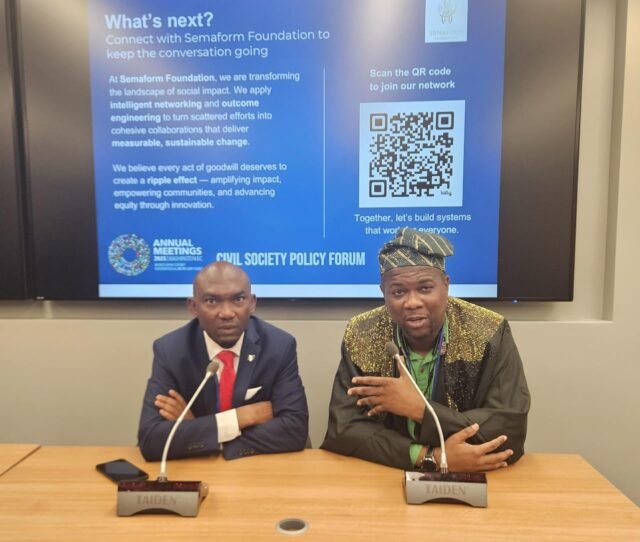
By Taiwo Akerele, PhD and Chaste Inegbedion
Across the corridors of the World Bank and the International Monetary Fund Spring Meetings, there is a familiar narrative taking shape, one of cautious optimism about Africa’s economic recovery.
Growth is projected to rebound. Inflationary pressures are stabilizing. Policy reforms are gaining recognition. And recent global decisions suggest that Africa’s financial systems are beginning to regain credibility.
But beneath this optimism lies a deeper truth. Africa cannot borrow its way to power. Not at 30 percent. Not at 36 percent. Not under conditions where the cost of capital makes long-term infrastructure not just difficult, but structurally impossible.
Let us be clear. Africa’s infrastructure gap, particularly in the power sector, is not a technology problem. It is a financing problem.
In developed markets, capital is priced in single digits. In many African economies, developers face commercial lending rates that make long-term investment irrational. And yet, these are the investments that determine whether hospitals function, whether schools can operate, whether industries can scale, and whether digital economies can exist at all.
Today, over 600 million Africans still lack access to electricity. At the same time, demand is accelerating, driven by artificial intelligence, data infrastructure, and an increasingly digital global economy that depends on reliable energy. This is not just a development issue. It is a competitiveness issue.
We acknowledge and commend the recent decision by the European Union to remove Nigeria, South Africa, and other African countries from its high-risk jurisdictions list, following their delisting from the Financial Action Task Force grey list.
This reflects meaningful progress in strengthening anti-money laundering and counterterrorism financing frameworks.
It is a positive signal. One that should reduce transaction costs, improve access to correspondent banking, and strengthen investor confidence.
But it is not enough.
Because while risk perception has improved globally, borrowing costs locally remain largely unchanged. This disconnect between perception and reality is where the real work begins.
Your Excellencies, the question before us is not whether capital exists. It is whether capital can be accessed at the scale, speed, and cost required to build the future.
First, we must democratize access to development finance. Today’s systems are too complex, too slow, and too exclusive.
Credible private infrastructure developers, those ready to build, remain locked out of capital pipelines that were not designed for them. This must change.
Second, we must scale what already works. Blended finance, guarantees, pooled funds, and regional financing platforms are not new ideas. They are proven tools.
The challenge is not innovation. The challenge is execution at scale.
Third, energy financing must be treated as foundational. Without power, there is no healthcare. No education. No digital transformation. No industrial growth. Energy is not a sector. It is the backbone of every sector.
Fourth, we call for a coordinated and time-bound capacity-building compact among Ministries of Finance, Central Banks, and Financial Intelligence Units. This compact must focus on institutional resilience, regulatory coordination, data systems modernization, and enforcement.
Africa’s transformation cannot be built on episodic compliance. It must be anchored in systems that are transparent, resilient, and capable of mobilizing both domestic and international capital efficiently.
Frameworks like the African Continental Free Trade Area present a historic opportunity to deepen intra-African trade, harmonize financial systems, and unlock regional capital flows. A fragmented continent will struggle to attract long-term investment.
The private sector must be treated not as an afterthought, but as a core partner. Financial institutions, fintech innovators, and capital market operators have a critical role to play in expanding access, reducing friction, and driving innovation across the financial ecosystem.
At the same time, transparency must remain non-negotiable. Strengthening anti-corruption institutions, modernizing public financial management, and investing in digital infrastructure are essential not only for compliance, but for building trust, both with citizens and with investors.
Africa represents roughly 3 percent of global GDP, yet it is home to over 1.2 billion people, vast natural resources, and the youngest population in the world. The fundamentals are strong. The potential is undeniable.
But potential does not build power plants.
The European Union’s decision is a vote of confidence. It signals that progress is being recognized. But recognition must now translate into results.
Build financial systems that are not only compliant, but competitive.
Unlock capital that is not only available, but accessible. Deliver infrastructure that is not only funded, but functional.
Africa cannot afford to wait. And it certainly cannot afford to borrow its way into stagnation. The future will not be built on promises. It will be built on capital that works.
–Akerele is the Executive Director of Policy House International and Inegbedion is from Semaform Foundation and ConcordeApp